
Chapter 2: The View Through the Glass
My brain simply failed to process the syllables. A sharp laugh escaped my throat before I could stop it.
“What do you mean, you already ate? Dinner was scheduled for five. It’s four-thirty.”
“Everyone was ravenous,” Mom replied, her voice dropping into a tense, hushed hiss. “The schedule shifted. I assumed you realized that.”
“Realized it from whom, Mom? You hearted my ETA text five hours ago!”
Behind me, Sophie stepped to the edge of the porch, her adolescent boredom instantly evaporating into acute suspicion. She leaned slightly to the right, peering through the gap in the heavy brocade living-room curtains.
“Mom,” Sophie said, her tone razor-sharp. “Look.”
I stepped around Mom’s defensive posture and looked through the glass.
The mahogany dining table—the table my father had refinished with his own hands when I was seven—was fully extended. Dana sat at the far end, Nate beside her. Flanking them were two older adults I recognized instantly as Nate’s parents, alongside his younger brother. Dad sat at the head of the table, a carving fork resting loosely in his fingers.
Every single plate was piled high with food. Steam was still curling off the serving bowls. And there, occupying the absolute center of the linen runner, rested the twenty-four-pound heritage turkey I had purchased, carved down the breastbone, its golden skin glistening beneath the chandelier.
They weren’t cleaning up. They weren’t nursing post-dinner coffees. They were actively, presently eating.
“They’re literally chewing right now,” Caleb observed from the top porch step, his voice echoing in the neighborhood silence.
Mom glanced back over her shoulder, her face draining of color, as if she had momentarily forgotten that exterior windows were made of transparent glass.
Ben tugged hard on the hem of my winter coat. His huge brown eyes were wide with confusion. “Mommy? But I can smell Grandma’s pie. Can’t I give her the turkey I made?”
“Margaret, please,” Mom whispered, her knuckles whitening on the door frame. “Do not create a scene on my porch in front of the little ones.”
A wave of dizzying heat surged behind my eyes. “A scene? Mom, open this door. My children have been in a car for four hours to see their grandparents on a holiday I funded.”
Sophie stepped forward, her posture rigid. “Can we just come inside and get a plate?”
Mom hesitated. It was an unmistakable, calculated hesitation. Then her gaze flickered, searching the yard for an escape route.
“Dana’s youngest… he’s been running a fever. He’s terribly ill. It’s not safe for Ben.”
I stared directly past her shoulder into the dining room. Through the window, Dana’s youngest son was happily dunking a buttery crescent roll into a pool of gravy, laughing at something his uncle had just said.
“He looks exceptionally vigorous for an invalid, Mom,” I said, my voice dropping to a dangerous, icy register.
“Margaret, you are being impossible!” Mom hissed, trying to close the gap to four inches. “It’s crowded! There aren’t enough chairs set up. We’ll pack you a tin of leftovers tomorrow!”
“Do not insult my intelligence,” I said. “You locked us out. With my children standing on your steps.”
“I am protecting this family’s peace!” she spat.
I looked down at Ben, who was staring down at his construction-paper bird, his lower lip trembling violently. I could have thrown my shoulder against that door. I could have marched into that dining room, overturned the porcelain gravy boat, and humiliated every adult seated at that table. But to what end? To force my children to sit in suffocating silence while strangers swallowed food I had bought?
“Keep the turkey, Linda,” I said quietly.
I turned my back on the woman who gave birth to me. “Kids. Back in the car.”
“Margaret, wait—” Mom started, but the heavy oak door snapped shut behind her.
We walked down the steps in total, absolute silence. Sophie was vibrating with fury; Caleb was bewildered; Ben was trying desperately not to sob. We piled back into the SUV. As I backed out of the crowded driveway, I caught a glimpse of the dining room window. A silhouette had parted the curtain—my sister Dana, staring out into the dusk, her fork suspended halfway to her mouth.
Ten minutes down the highway, Ben completely collapsed into tears.
“Was Grandma mad at me?” he sobbed, crumpling the orange paper feather in his small fist. “Did I make the wrong turkey?”
That sound sheared something vital inside of me. I pulled over onto the gravel shoulder of the highway, unbuckled my seatbelt, climbed into the backseat, and pulled him into my lap.
“No, my love,” I told him, smoothing down his hair while Sophie wiped away an angry tear of her own. “Grandma’s behavior has nothing to do with you, or your art, or anything you did. Grandma made an adult choice. A profoundly broken, selfish choice.”
We drove forty miles to an all-night diner situated just off the interstate. Our Thanksgiving banquet was a bizarre, greasy feast of chocolate milkshakes, crispy chicken tenders, towering stacks of buttermilk pancakes, and a single, lopsided triangle of commercial pumpkin pie that looked like it had survived a minor vehicular collision.
Sophie took a picture of the sad pie, held it up to the fluorescent lights, and deadpanned, “New family tradition.”
Caleb began building an elaborate suspension bridge out of plastic creamer tubs, and slowly, the darkness lifted enough for us to breathe. We laughed until our ribs ached, defying the coldness waiting forty miles behind us.
By the time we returned to my home in Salt Lake City, the kids were exhausted, their bellies full of syrup and diner fries. I tucked Ben into bed, smoothed his paper turkey flat on his nightstand, and walked into my dark home office.
I didn’t turn on the overhead lights. I sat down at my desk, opened my laptop, and navigated straight to my online banking portal.
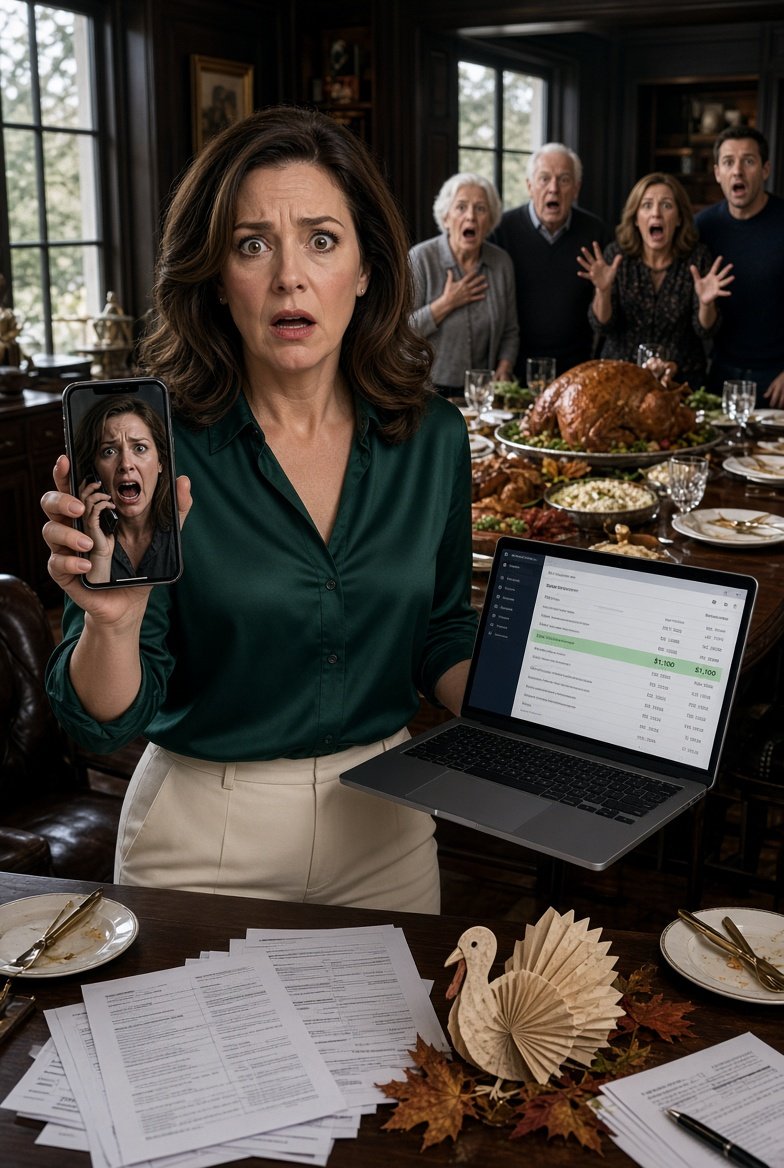
Without a trace of hesitation, I located the recurring automated transfer: $1,100.00 to Linda & Richard Damon.
I clicked Cancel.
No vindictive memo. No farewell manifesto. Just a clean, digital severance.
I assumed I knew the entire story. Dana was the golden child; I was the disposable ATM. Mom preferred the local family and had pushed me out to play the martyr. It was cruel, it was classic favoritism, but it felt familiar.
At 10:41 PM, my phone illuminated on the desk. Mom. I let it ring into silence.
At 10:53 PM, she rang again.
At 11:03 PM, an incoming text message shattered the quiet: Margaret, the power went out on our street and the bank just sent an alert saying the auto-draft was cancelled. What did you do?
I stared at the screen. Not Why did you cancel the money you send us?
The auto-draft.
I typed back: What auto-draft?
The three typing dots appeared, vanished, appeared again, and then: Do not start this tonight. Your father cannot take the stress.
Before I could type a rejoinder, the screen shifted. An incoming call from Dana.
I swiped the bar. “Yes, Dana?”
“Seriously, Margaret?” Dana’s voice was shrill, laced with panic and indignation. “You cancelled it? Tonight of all nights?”
“Cancelled what, Dana?”
“The house payment! Mom is beside herself!”
I slowly pushed back from my desk and stood up in the dark office. “What did you just say to me?”