
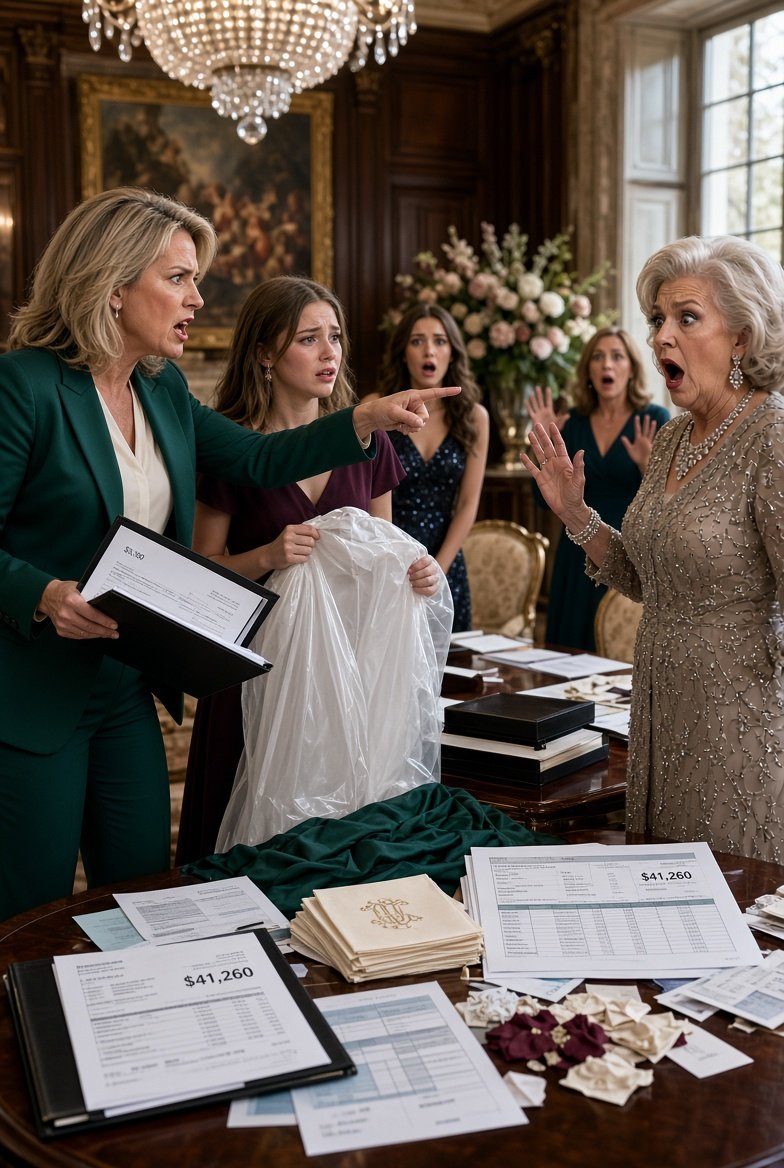
Chapter 4: The Demolition of the Matriarch
Linda’s voice did not sound like that of an elegant suburban grandmother. It sounded like an iron grate being dragged over broken masonry.
“What did you say to your sister?” she demanded, her breath hitching with rage. “Cheryl is in hysterics! She’s threatening to cancel Madison’s tickets! How dare you weaponize your money to terrorize this family?”
“I didn’t weaponize my money, Mother,” I replied calmly, resting my forearms against the desk. “I simply withdrew it from circulation. There is a distinct operational difference.”
“You made Cheryl feel like a common criminal!”
“Cheryl accepted stolen goods. Whether she did so out of willful ignorance or sheer idiocy is an academic question. The money has been refunded to your account. I suggest you leave it there to cover your overdrafts.”
“You think you’re so clever,” Linda spat. “You think because your father left you that little manufacturing shed, you can lord your wealth over people who possess actual refinement! Well, let me tell you something, Deborah: Sophie will never be Madison. She doesn’t have the poise, she doesn’t have the charm, and putting her in a three-thousand-dollar costume isn’t going to turn an awkward, plain girl into a swan!”
A cold, diamond-hard clarity settled over my central nervous system.
Every insult she had ever leveled against me—every backhanded compliment about my broad shoulders, my business suits, my unfeminine ambition—had been transferred directly onto my child. The ledger was no longer merely out of balance; the entire ledger was an instrument of abuse.
“Have you checked your personal email this afternoon, Mother?” I asked softly.
A beat of absolute stillness occurred on the other end of the line.
“What are you talking about?”
“I suggest you open your inbox.”
I heard the distant, uneven clicking of her mouse. Then came a sharp, audible gasp.
“What… what is this?” Her voice lost its gravel, ascending into a thin, breathless whistle. “The Foundry… Leah sent a notice of cancellation. There must be an error. The catering… the florist… Deborah, what did you do?”
“I cancelled your sixtieth birthday party,” I told her.
“You… you can’t cancel my party! It’s four weeks away! A hundred and twenty people have already RSVP’d! The invitations were mailed on engraved cardstock!”
“Then you had better begin drafting the retraction cards,” I said. “Because the room is gone. The swing band has been released. The seafood towers have been cancelled. The five-tier cake with the edible gold leaf has been wiped from the baker’s schedule.”
“You spent forty thousand dollars on that contract!” she screamed, the sound tearing at the microphone of her phone. “You signed the agreements!”
“And I have absorbed the cancellation penalties,” I replied. “Six thousand seven hundred dollars, to be precise. It is an expensive fee for an afternoon of emotional clarity, but compared to the cost of enduring another decade of your parasitic arrogance, it is the greatest bargain of my commercial life.”
“You are a monster!” she wailed. “A cruel, ungrateful, unnatural daughter! Your father would turn over in his grave if he could see what you’ve become!”
“If my father were alive, Mother,” I said, my voice dropping an octave until it resonated with the cold authority of Arthur Barnes himself, “he would look you in your face, he would tell you that the ledger is closed, and he would walk out of the room. Do not call my house again.”
I tapped the red icon. The call severed.
I blocked her number on my cell phone. I blocked her on my home landline. Then I sat back in my leather chair and let the silence wash over me.
Yet, Linda Barnes was not an adversary who understood the concept of unconditional surrender. By noon the following day, the true insanity of her counter-offensive arrived directly on my factory floor.