
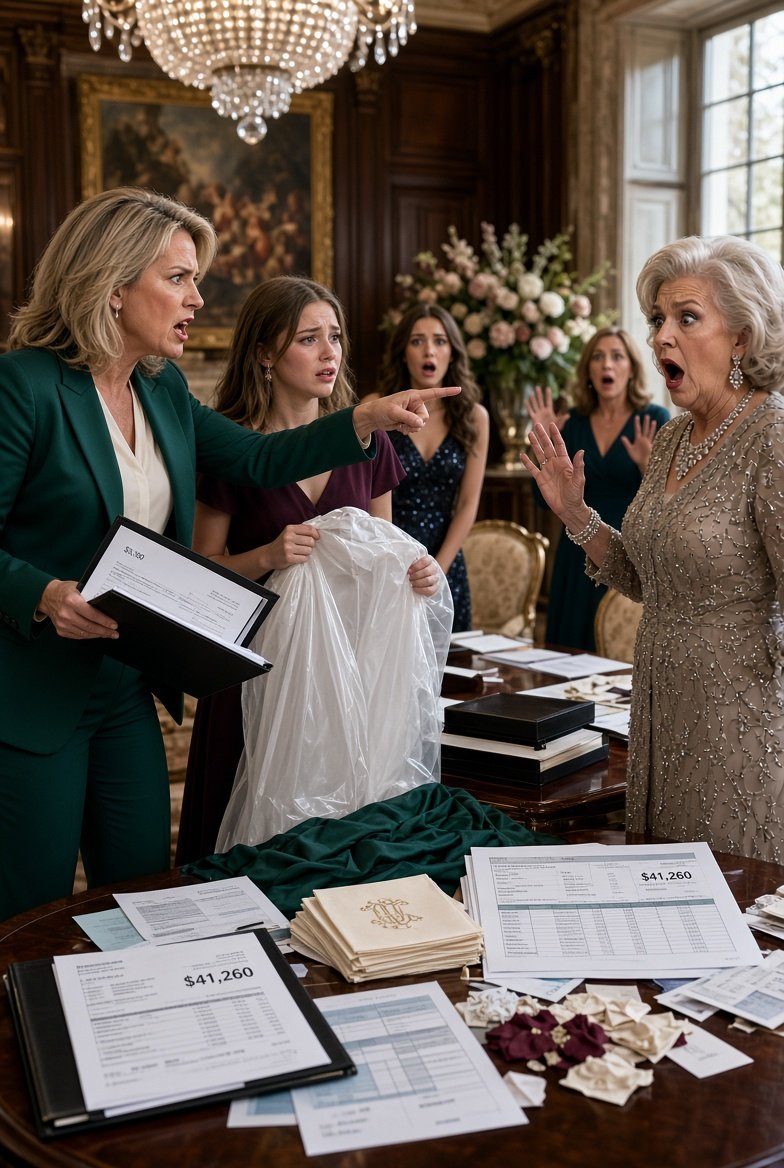
Chapter 5: The Industrial Insurgency
At twenty minutes past ten on Thursday morning, Tanya, my veteran office manager, walked into my office without knocking.
Tanya had survived two decades of corrugated manufacturing; she had seen employees lose finger joints to hydraulic presses and had once stared down an armed repo man during our 2008 cash-flow crisis without dropping her clipboard.
Now, her face was completely devoid of expression, which in Tanya’s case signaled imminent structural catastrophe.
“Deborah,” Tanya said carefully. “Are we hosting a private social engagement in Warehouse B on the evening of May twenty-third?”
I slowly set down my red editing pen.
“Warehouse B?” I asked. “The distribution depot with thirty-foot ceilings, forty-eight pallet racks of unbleached pulp board, and three active loading docks?”
“The very same,” Tanya nodded, consulting a printed memo. “Your mother called reception forty minutes ago. She spoke with young Tiffany at the front desk. She informed her that due to an administrative scheduling conflict at her primary venue, you had generously offered to relocate her milestone celebration to the corporate facility.”
My jaw did not drop. My body had simply run out of the biochemical capacity for surprise.
“Go on,” I said.
“She instructed Tiffany to have our maintenance crew empty the western staging bay by three o’clock on Saturday afternoon,” Tanya read from her notes. “She requested that Earl and the forklift drivers remain on site to help the decorators suspend ivory drapery from the structural steel girders to hide the raw material inventory. She also wanted to know if our commercial break room had sufficient commercial refrigeration for forty cases of prosecco.”
I rubbed the bridge of my nose, feeling a strange, hysterical chuckle bubbling at the base of my throat.
“She tried to turn my manufacturing plant into a ballroom,” I murmured.
“She called it Industrial Chic,” Tanya said without a smile. “She told Tiffany that exposed brick and steel trusses are currently very fashionable in Manhattan, and since you already own the building, the overhead would be practically zero.”
“Is that all?”
“Not quite,” Tanya sighed, turning the page. “She asked if we carried gold-tinted compostable cutlery in our standard catalog. Because she assumed she wouldn’t have to pay for the tableware.”
I stood up, walked around my desk, and looked through the plate glass window down into the humming belly of the plant. Below, forklift number three—driven by Earl, a sixty-two-year-old Vietnam veteran who had worked for my father before he worked for me—was reversing out of an aisle, its amber warning beacon flashing rhythmically against the concrete floor.
The sheer, monumental audacity of Linda Barnes was almost breathtaking. Having been stripped of her forty-thousand-dollar palace, she had looked at my life’s work—the enterprise that paid the mortgages of thirty-eight human beings—and viewed it as nothing more than a complimentary banquet hall with free parking.
“Did she issue invitations?” I asked.
The answer arrived fifteen minutes later via Greg, our shipping supervisor.
Greg walked into the office clutching a printout of an email blast that his wife’s cousin had just forwarded him. At the top of the digital card was an image of my mother draped in cream-colored cashmere, beneath which was printed in elegant, swirling gold script:
A Change of Scenery for a Sensational Milestone!
Join Linda Barnes as we celebrate Sixty Years of Elegance
at an exclusive, private evening of Industrial Sophistication.
Hosted at Barnes Paper and Table Company
8400 River Road, Philadelphia
Attire: Factory Chic / Black Tie Optional
“Deborah,” Greg said, scratching his gray beard. “My wife’s cousin wants to know if there’s gonna be valet parking near the compactor.”
“Tell your wife’s cousin to stay home, Greg,” I said.
I sat at Tanya’s terminal. I drafted a single, corporate memorandum using our official enterprise letterhead:
TO: ALL INVENTORIED CONTACTS AND ASSOCIATES OF LINDA BARNES
FROM: DEBORAH BARNES, PRESIDENT & MANAGING DIRECTOR, BARNES PAPER AND TABLE CO.
SUBJECT: UNAUTHORIZED EVENT SOLICITATION
Please be advised that Barnes Paper and Table Company is an active, heavy manufacturing facility operating under strict federal and occupational safety protocols. No private social gatherings, galas, or milestone receptions are scheduled, authorized, or permitted on these premises on May 23rd, or any date thereafter.
Any individuals attempting to enter the industrial yard or warehouse facilities for non-commercial purposes will be turned away by private security and cited for criminal trespass.
The company will operate its standard third-shift distribution schedule without interruption.
Sincerely,
Deborah Barnes
“Send it to every address my mother has ever shared with this office,” I instructed Tanya. “And notify our perimeter security provider to double the gate guards on the twenty-third.”
The final blow arrived on Friday afternoon in the form of a commercial flatbed truck from an architectural signage firm in New Jersey.
The driver walked into our reception area holding a freight bill. Behind him, resting on the bed of the truck, was a seven-foot-tall, free-standing structure made of mirror-polished gold acrylic. It was shaped like a giant numeral sixty, surrounded by an explosion of laser-cut plastic stars, with the name LINDA emblazoned across the base in illuminated LED lettering.
“Got a delivery for Barnes Paper,” the driver announced. “Customer said to drop it at Loading Dock B.”
Earl, who was walking past with a mug of black coffee, stopped dead in his tracks. He stared at the golden monstrosity, then looked at me.
“Safety week?” Earl asked deadpan. “We gonna mount that over line four?”
“Refuse the shipment, driver,” I said, handing the bill of lading back without signing it. “Return to sender.”
“Customer said it’s non-refundable, lady,” the driver grunted.
“Then take it to the address listed under the billing contact,” I said. “And if it doesn’t fit through her front door, leave it on her lawn.”
Two hours later, my aunt Denise—Linda’s younger sister and the only member of the extended family who possessed a functional moral compass—sent me a photograph from her iPhone.
The seven-foot gold acrylic monument was currently leaning against the wall of Denise’s detached garage, jammed ignominiously between an electric snowblower, two plastic garbage bins, and a fifty-pound bag of high-nitrogen turf fertilizer.
Denise’s text message beneath the image contained only three words: Sic semper tyrannis.