
Chapter 2: The Void and the Ledger
The Kettering Police Station is a squat, brick fortress that constantly smells of ammonia and cheap floor wax. They deposited me in an interrogation room featuring a steel table bolted directly into the concrete. A young, green officer handed me a paper cup of tepid water that I left untouched.
Nobody uttered the word charged. Nobody uttered the word released.
They pressed my fingertips onto a glass biometric scanner and photographed my tear-streaked face against a height chart. A female officer named Lutz asked if I had any medical conditions.
“I’m a nurse,” I murmured, the reality of my suspended license already choking me. She noted it without a flicker of empathy, logging it the way one might note an allergy to penicillin.
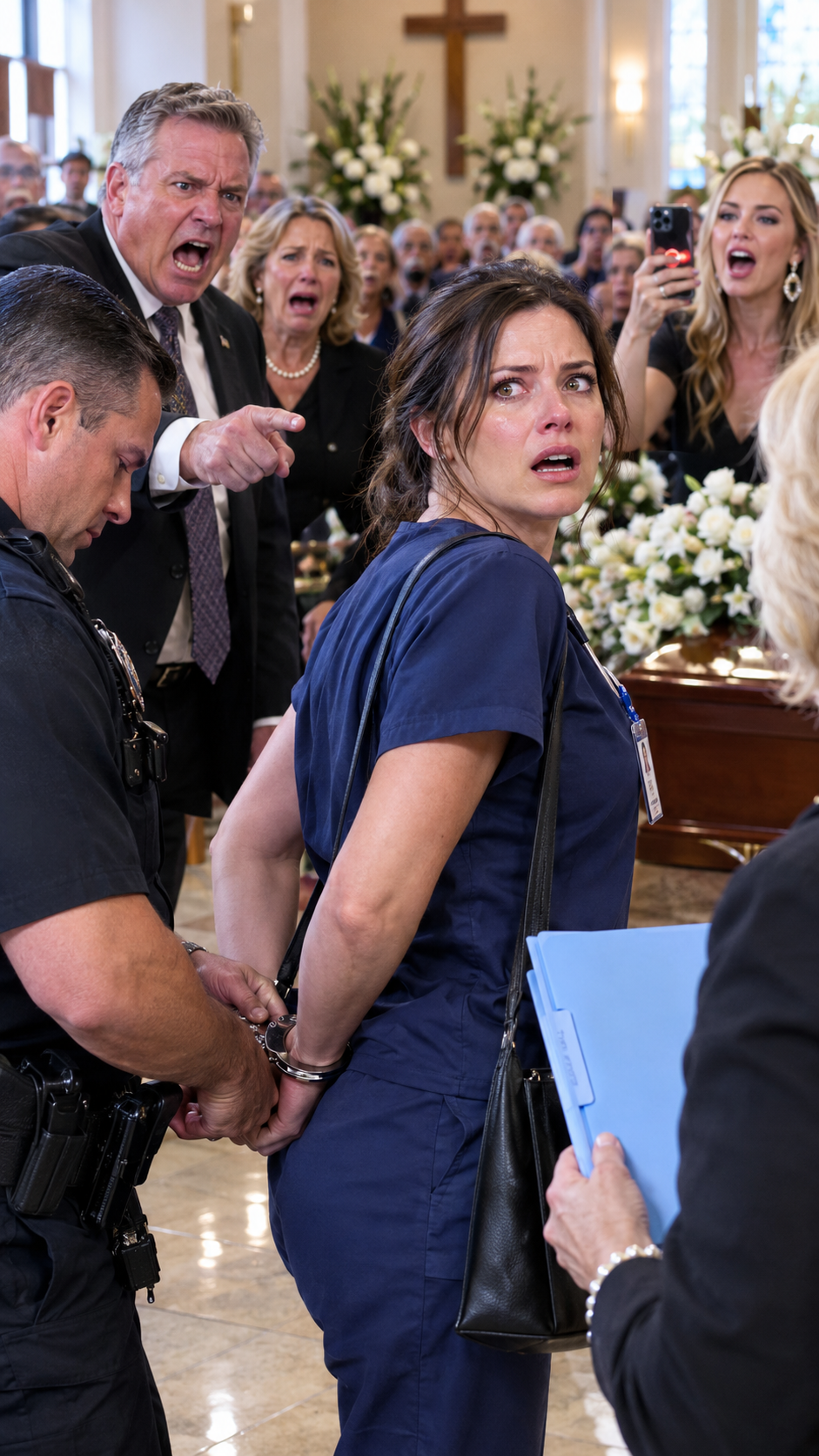
For two hours, I sat in that freezing room in my black funeral dress. My mind drifted back to the kitchen table on Ridgeway Road, to the woman who had graded my math homework there decades ago. My grandmother, Eleanor Peterson, had taught high school algebra for thirty-four years. When I was fourteen—the age when my parents had permanently affixed the label of difficult child to my forehead—Grandma Eleanor had limitless patience for me.
“Anybody can guess the answer, Joyce,” she used to say, tapping her pencil against my worksheet. “Half credit for the right number. Full credit only when you show me the work. Show me how you got there.”
The heavy metal door clicked open, dragging me back to the present. Detective Carol Hensley from the Elder Crimes Unit stepped inside. She was a woman in her mid-fifties, with reading glasses perched atop a messy bun of graying hair, wearing the specific kind of exhaustion that comes from a decade of listening to greedy families lie about inheritance.
She dropped a thin, manila folder onto the steel table. It wasn’t my mother’s light blue trap. This one had a yellow tab, and the edges of the paper inside looked weathered.
She booted up her laptop, typed for a moment, and then stopped. Her eyes scanned the screen, darted to the yellow folder, and then fixed onto me. Her entire posture shifted. The adversarial tension drained from her shoulders, replaced by a sharp, calculating curiosity.
“You are the registered agent on Eleanor Peterson’s durable power of attorney,” she stated, not a question.
“Yes,” I rasped.
“Notarized February 18th of last year. Drafted by an attorney named Nora Whitfield.” She leaned forward, closing the manila folder halfway, shielding its contents. “Your family has absolutely no idea you have this, do they?”
“Have what?”
“A full, legally binding power of attorney that is already on file with this department,” Hensley said softly. “Attached to a protective document your grandmother filed herself, fourteen months ago.”
My pulse hammered behind my eyes. “What did she file?”
Hensley shook her head, a sympathetic but firm refusal. “I cannot show you this file. But I can tell you that the bank transfers your mother so enthusiastically reported as theft were executed by a person your grandmother explicitly authorized in writing. In front of a notary. With a licensed physician’s cognitive evaluation attached to it.” She tapped the folder. “This isn’t criminal theft, Joyce. This is just bulletproof paperwork.”
I stared at the water cup, my hands shaking so violently I had to press them flat against my thighs. “Then why did you arrest me at her funeral?”
“Because your mother filed a sworn, signed affidavit regarding a stolen wedding ring,” the detective explained, standing up. “And because a formal complaint does not magically close itself. I am waiting on the full, unredacted bank records.”
She opened the door. “You are being released pending further investigation. No charges are being filed tonight. Do not leave the county, and do not contact the complainants.” She paused in the doorframe, offering a cryptic smirk. “And if I were you, I would have a very long chat with whoever it was that drove your grandmother to her appointments last February.”
Before I could ask how she knew about a phantom driver, she was gone.
They released me into the humid Ohio evening. While waiting for a rideshare in the precinct parking lot, I powered my phone back on. The screen exploded. Sixty-three text messages. Four missed calls from Denise Albright, the Director of Nursing at Brightwater Home Health, my employer.
Nothing from my mother. Nothing from my father. Nothing from Brittany.
Denise’s final text was ominous: Call me immediately. Not tomorrow morning. Tonight.
I couldn’t face Denise yet. I opened Instagram instead. Brittany’s live stream was pinned to her profile. It was twenty-two minutes long. The view count already possessed a comma. The comments were a firing squad, demanding my nursing license be revoked, branding me a vulture who preyed on the elderly.
I barely slept. Monday morning, I met Denise in the Brightwater lobby. She intercepted me before I could even reach the elevators, guiding me into her office and shutting the blinds.
“Five families called our corporate office over the weekend, Joyce,” Denise said, her voice tight. “Five. Our compliance officer is demanding to know why our lead geriatric care manager is the star of a local crime watch group.”
“Denise, it’s a lie. My parents—”
She held up a hand. “I’ve audited your charting for a decade. I know you didn’t do this. I am not building a case against you. But I am forced to put you on administrative leave, with pay, until the police formally clear your name. Corporate’s hands are tied.”
I unclipped my hospital badge and set it quietly on her desk. My fourteen patients—the elderly men and women I managed, the medications I balanced, the hands I held—were being stripped away.
Driving away from the clinic, a hollow ache settled in my chest. On autopilot, I drove to Ridgeway Road. Grandma’s mail had been accumulating, and I still possessed the house key I had used every morning for the past two years.
I stepped onto the porch and slid the key into the lock. It wouldn’t turn.
I looked closer. The deadbolt was brand new, gleaming brass. Taped to the inside of the glass storm door was a neon index card. My father’s aggressive block lettering stared back at me: PROPERTY OF THE ESTATE OF ELEANOR PETERSON. NO ENTRY WITHOUT AUTHORIZATION. – D. PETERSON.
I backed away from the door, a cold realization washing over me. The blue folder my mother had given the police… the bank statements with the yellow highlighter. Grandma’s physical bank statements were still mailed to this address. My mother had broken in. She had sifted through the old woman’s mail, cherry-picked the pages showing money moving out of the account, and conveniently destroyed the pages showing it moving into a protected care account.
I snapped a photo of the index card and sent it to Nora Whitfield, the elder law attorney I hadn’t spoken to in a year.
Her reply was instantaneous: Do not engage. Document the lockout. We will slaughter them on paper, not on a porch.
I returned to my apartment, exhausted to my marrow. I dropped my tote bag onto the kitchen island. Inside it was the box of photo albums, and resting on top of them was the last object my grandmother had ever handed me: a tattered, green cloth notebook.
I hadn’t opened it since the day she died. I poured a glass of cheap wine, sat at my counter, and finally flipped open the cover.
The first page was dated 1960. Rent: $22. Milk, gas, a church envelope. Her handwriting was impeccable, identical to the script she used to correct my algebra. Sixty-six years of a woman meticulously tracking every cent she was owed, and every cent she owed the world.
I turned the fragile pages for hours, letting her essence wash over me. I found an entry in May 2009. J. Tuition – $6,200. Don’t tell Dale. I wept. She had recorded my college tuition in the same matter-of-fact column as her furnace filters.
Then, I reached January 2022. The neat handwriting remained, but the rhythm of the entries shattered.
D. Card – $2,000
February: D. Card – $2,500
March: D. Card – $2,900
I stopped breathing. I counted the lines. Thirty-six entries spanning three years. Every month, a withdrawal ranging from $1,200 to $2,900. She never wrote a narrative beside them. No exclamation points. No questions. Just the irrefutable data, recorded by a woman who had graded math for three decades and understood exactly what a parasite looked like.
The final D. Card entry was in January 2025. Beneath it, she had drawn a thick, heavy line, tallying the column.
$61,000.
Next to the total, written in a furious, pressing hand that had nearly torn the paper, was a single word underlined twice:
Enough.
My mind flashed to my father’s enraged phone call a year ago, screaming that his supplementary card had been declined at the pharmacy. He had been bleeding her dry for three years. She had caught him. She had calculated the theft to the penny, cut off his access, and never breathed a word of it to me.
I turned the page. February 2025 contained three peculiar entries.
Feb 4: NW – $350 (Nora Whitfield, Attorney)
Feb 11: Dr. H – $40 Copay
Feb 12: L. drove – $0
Aunt Lorraine, her eighty-three-year-old sister, had driven her somewhere. And Grandma had deemed it necessary to document that the trip cost zero dollars.
As I closed the book to process the revelation, my thumb snagged on the back cover. It was unusually thick. I grabbed a butter knife from the drawer and carefully pried back the cloth lining.
Taped to the cardboard spine was a small, flat brass key with the number 218 stamped into the metal. Beneath it was a folded scrap of paper.
Heartland Bank. You are on the box. E. For later.
Cliffhanger: The trap my parents set was loud and vicious, but my grandmother’s trap was silent, buried in ink, and the timer had just hit zero.