
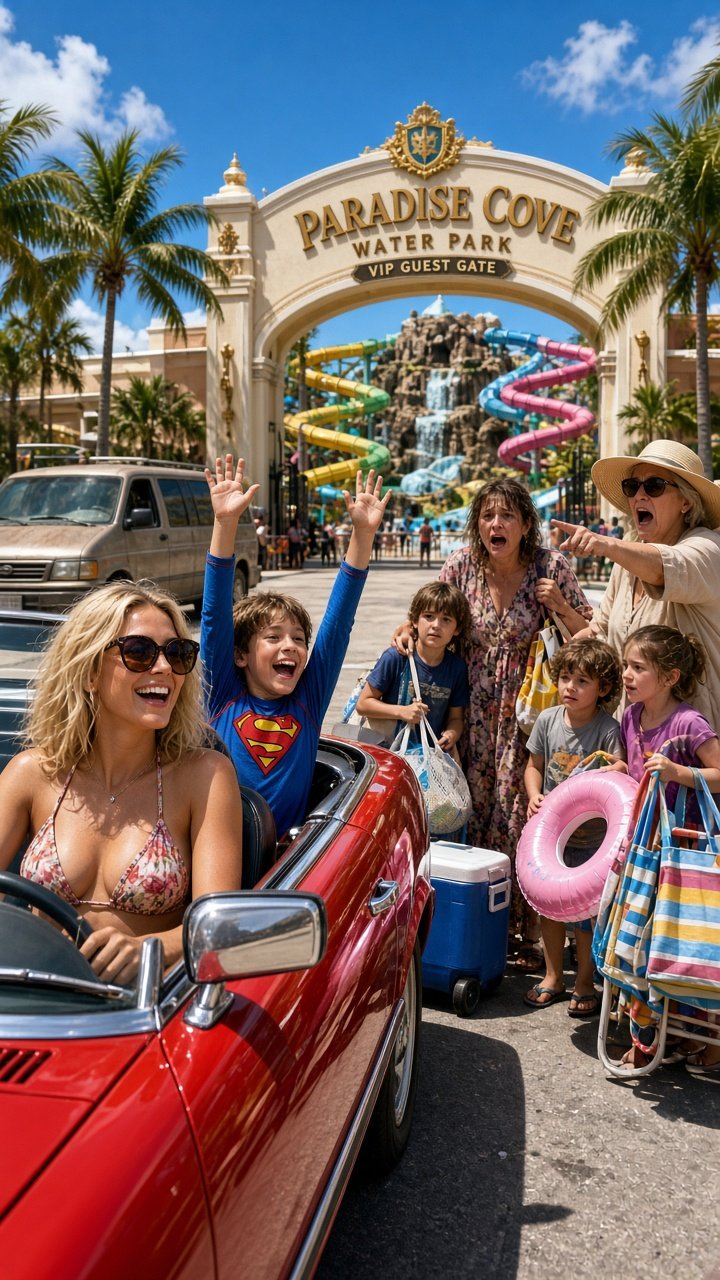
Mom waved: “Next time!” I took my son myself. VIP passes. $450. Then I cancelled the gas card my sister used every week. My account. $600/month. When she pulled up to the pump on empty…

Chapter 1: The Three Empty Seats
“Your son can’t ride with us. There’s no room,” my sister stated, her voice as casual as if she were commenting on the weather.
I blinked against the glaring morning sun. There were three empty seats.
My son, Mason, watched through the tinted glass as his three cousins buckled up for the highly anticipated trip to the Blue Harbor Water Park. My mother, safely ensconced in the passenger seat, offered a limp, apologetic wave. Next time, she mouthed through the glass.
There wouldn’t be a next time with them. I took my son myself. I swiped my debit card for two VIP passes, totaling four hundred and fifty dollars. And then, later that same evening, sitting alone at my kitchen table, I logged into my banking portal and permanently deactivated the auxiliary gas card my sister had been bleeding dry for nearly a year. My account was instantly six hundred dollars a month richer.
When Melissa inevitably pulled up to pump number six on fumes the following Saturday and realized her golden goose had been slaughtered, Mason was safely back in my apartment, examining a sunburn that looked like a minor radiation leak. He was nine years old. He had been obsessing over the water park for six consecutive days. I know this with absolute certainty because I had endured the exact phrasing of the question, “Mom, do you honestly think I’m tall enough for the Thunderdrop?” roughly four hundred times. He asked it while I was brushing my teeth. He shouted it through the bathroom door while I was desperately trying to pee.
The entire excursion was Melissa’s brainchild. She has three children: Abby, Connor, and Luke. Every July, like a chaotic migration, she herds them to Blue Harbor. My mother inevitably tags along, primarily because Mom views herself as an elite specialist in supervising children from the safety of a shaded lounge chair while actively consuming someone else’s expensive French fries.
Melissa had explicitly told Mason the previous Sunday, right in my cramped living room, that he was included. She said it directly to his face. Of course, you can come, buddy. We’ll swing by and grab you at Grandma’s house.
So, like an idiot, I prepped. I packed his favorite Spiderman towel, a change of dry clothes, two water bottles, water shoes, a specialized plastic pouch for his phone, an arsenal of snacks, and a crisp twenty-dollar bill. I provided the cash because, apparently, aquatic amusement parks charge eleven dollars for a culinary atrocity called “Loaded Nachos”—a dish that consists of stale chips buried under enough sour cream to require a mortgage application.
My name is Teresa. I am thirty-six years old, and I clock forty hours a week as a lead cashier at a regional grocery chain. I am decidedly not wealthy. I feel the need to broadcast this fact because my family operates under the bizarre delusion that the moment an individual learns how to pay their utility bills on time, they magically transform into a Rockefeller.
I rent a clean, incredibly basic two-bedroom apartment. My sedan is pushing eight years old and makes a suspicious rattling noise over fifty miles per hour. I possess a modest savings account entirely because I hoard extra weekend shifts like a squirrel hoarding nuts, and because I engage in radical financial strategies like not purchasing a new set of decorative throw pillows every time Target dictates a change of season.
Melissa has never grasped this concept. Last autumn, she dropped forty-eight dollars on a distressed wooden sign that simply read Gather in cursive font. Two days later, she called me sobbing because she was fifty dollars short on her electric bill. Apparently, the decorative sign possessed zero magical abilities to actually gather currency.
Regardless, Mason and I pulled into my mother’s driveway promptly at eight that Saturday morning. It was the designated staging ground. Melissa arrived fifteen minutes late, piloting her silver monolith of a minivan. That vehicle was a structural marvel; it could comfortably transport a youth soccer team, three medium-sized farm animals, and a chest freezer. It boasted eight individual seats.
Melissa took the wheel. Mom claimed shotgun. Abby and Connor occupied the middle captain’s chairs. Luke was sprawling in the far back.
Three completely unoccupied seats. I saw them. Mason saw them. The neighborhood stray cat probably saw them.
Mason, practically vibrating with excitement, grabbed his backpack and sprinted toward the van, his smile so bright it could have powered a small city. Melissa stepped out of the driver’s side to rearrange something in the cavernous trunk. She was wrestling with two canvas pool bags, a heavy-duty cooler, and an inflatable alligator that was already half-inflated for reasons that defied all logic and physics.
“Aunt Melissa,” Mason chirped, hovering near the sliding door, “should I sit in the very back with Luke?”
Melissa didn’t even have the decency to feign embarrassment. She didn’t hesitate. She just looked at my nine-year-old son and said, “Actually, honey, you can’t ride with us today. There’s simply no room.”
Mason froze.
I peered past her shoulder into the interior of the van. Sometimes, when a person utters something so profoundly stupid, your brain short-circuits and forces you to verify reality. Nope. Reality remained unchanged. Three empty seats.
“Melissa, there are literally three empty seats,” I stated, my voice dangerously flat.
Melissa released a heavy, theatrical sigh. It wasn’t a standard exhale of frustration. It was the specific, exaggerated sigh people deploy when you ask them to explain string theory while they’re trying to carry eight bags of groceries.
“Well, Teresa, we need the room for our stuff.”
I looked at the “stuff.” Two canvas bags, one standard cooler, and the partially inflated plastic reptile, which had apparently just been promoted above my actual human child in my sister’s transportation hierarchy.
“Put the bags in the trunk,” I suggested.
“The trunk is entirely full.”
I walked around her and looked into the trunk. It was aggressively not full. It contained four beach towels, one folding canvas chair, a bottle of aerosol sunscreen, and a plastic grocery bag containing exactly six hamburger buns. I couldn’t even begin to fathom the logic behind the hamburger buns. The water park had a strict, heavily enforced no-outside-food policy. Perhaps Melissa was anticipating a severe, unexpected hot dog emergency on the highway.
Mason looked up at me, his eyes wide and shiny. Then he looked back at the monolith. He didn’t cry. That lack of tears almost gutted me worse than a tantrum would have. He just adjusted his backpack straps and mumbled, “It’s okay, Mom.”
Right on cue, Mom emerged from the front door wearing an enormous, woven sun hat. Her summer headwear seems to increase in diameter annually. At this current trajectory, I suspect she is attempting to achieve total, localized climate control.
“What on earth is the holdup?” Mom demanded, adjusting her sunglasses.
“Melissa is claiming there’s no room for Mason,” I said, pointing to the cavernous vehicle.
Mom leaned over and peered into the van. She possessed functioning corneas; she could clearly see the acres of empty upholstery. Then, her face contorted into the exact, practiced expression she always deployed when Melissa did something indefensibly selfish. Over the years, Mom had calculated that actively parenting Melissa required far more caloric energy than simply sacrificing the feelings of anyone standing in the blast radius.
“Oh, honey,” Mom cooed, leaning down to pat Mason’s shoulder. “Maybe next time.”
Then, she smiled. She actually, genuinely smiled at him, as if she had just informed him that the local ice cream parlor was out of vanilla, rather than confirming he was being abandoned in a suburban driveway because a vinyl alligator required premium legroom.
Melissa scrambled back behind the wheel. Mom hauled herself into the passenger seat. Through the tinted glass, the cousins waved. Poor Abby, possessing a shred of empathy, cracked her window and yelled, “Mason can just sit by me!”
Melissa immediately barked, “No, sweetie. Roll that up and buckle your belt.”
Then, she put the van in drive and rolled away.
Mason and I walked silently back inside Mom’s house because I had left my purse resting on the kitchen island. He bypassed the kitchen entirely, marching straight to the front window. He stood there, his small hands pressed against the glass, watching the silver van turn right at the end of the cul-de-sac.
Mom, oblivious to the cruelty, waved at him through the passenger window.
Next time! she hollered, her voice muffled by the glass.
I will carry that specific image with me to my grave because Mason raised his hand and waved back. It was a very small, incredibly polite wave. He looked exactly like an exhausted waiter watching a table of obnoxious customers leave the restaurant after they had completely stiffed him on the tip.
I stood there in the quiet kitchen for perhaps five seconds, letting the rage calcify into something cold and sharp. Then, I snatched my purse off the counter.
“Grab your backpack, Mason.”
He turned away from the window, confusion knitting his brow. “Why? Where are we going?”
“We’re going to Blue Harbor.”
His entire posture shifted. His face lit up. “Really? But… what about Aunt Melissa?”
“What about her?”
That was the absolute zenith of my dramatics. I wasn’t plotting a cinematic revenge arc. I wasn’t scripting a monologue. I just possessed a singular, undeniable truth: my son was not going to spend his Saturday rotting on our apartment sofa, watching reruns of SpongeBob, while his cousins rode water slides simply because three adults had collectively decided that beach towels required assigned seating.
I was about to make a financial decision that would alter the ecosystem of my family forever.