
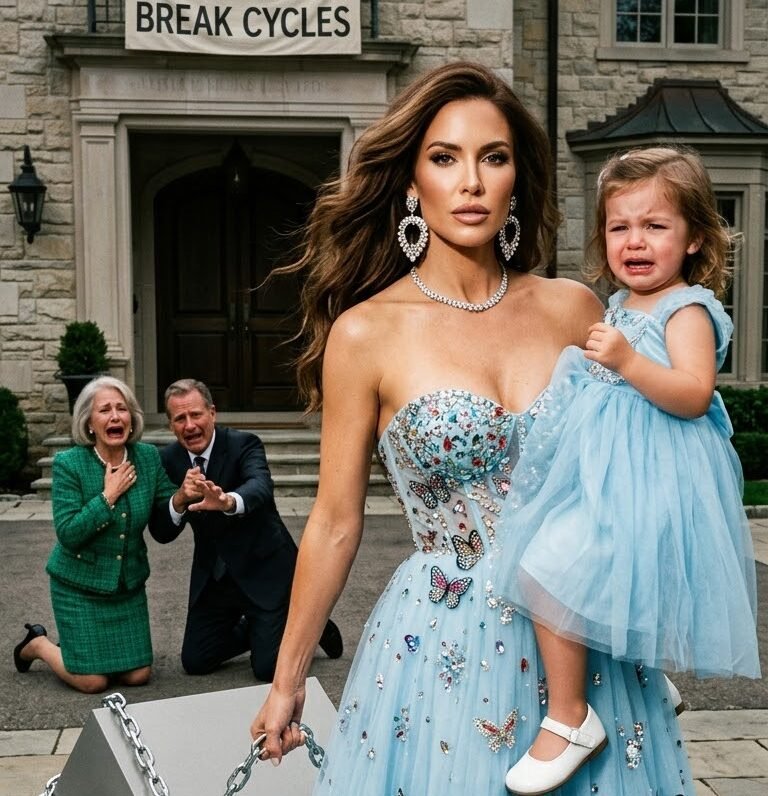
But when I came home, I found my refrigerator padlocked—and my 6-year-old daughter kneeling on the kitchen floor, crying from hunger. My MIL sat there eating a sandwich and sneered, “To eat in this house, you must beg for my permission.” I didn’t shed a tear. I grabbed a hammer, smashed the padlock apart, and picked up my sobbing child. Then I made one call: “Tear the whole thing down.”

Chapter 1: The Price of Peace
There is a profound, insidious danger in believing that generosity can purchase peace. When you hand an abuser a blank check, hoping it will buy their respect, you do not build a bridge; you simply fund the construction of the very fortress they will use to lay siege to your life. You convince yourself that your financial sacrifices are acts of love, completely oblivious to the horrifying reality that you are actively financing your own hostage situation.
For the first six years of my marriage to David, I was the primary breadwinner, the shock absorber, and the silent, accommodating foundation upon which his entire, fragile reality rested.
I, Elena, was a highly successful, senior corporate acquisitions analyst. I worked grueling, sixty-hour weeks in a cutthroat, male-dominated industry. My success afforded us a sprawling, custom-built, modern estate in an affluent suburb of Seattle.
David was a mid-level manager at a logistics firm. He drove a leased sports car he couldn’t afford without my income, and he possessed the unearned, arrogant confidence of a man who believed his mere presence was a gift to the world. He was chronically allergic to conflict, specifically any conflict involving his mother, Agnes.
Agnes was a woman constructed entirely of toxic, aristocratic entitlement and venomous, passive-aggressive cruelty. She lived in an aging, massive, drafty Victorian home on the other side of the city—a house that was slowly, literally falling apart around her, much like her own relevance.
She despised me. She viewed my career not as an accomplishment, but as a direct, aggressive insult to her son’s masculinity. To Agnes, I was not a daughter-in-law; I was a glorified, uppity bank account holding her son hostage.
Four weeks ago, Agnes’s kitchen had suffered a catastrophic plumbing failure, resulting in severe water damage that required the entire room to be gutted down to the studs.
Faced with a massive repair bill she couldn’t pay, David had come to me, wringing his hands, begging for help. He deployed his usual, manipulative tactics, claiming his mother was elderly and vulnerable.
Against every single screaming instinct in my gut, I caved. I wanted a quiet, peaceful holiday season.
I wrote a massive, twenty-five-thousand-dollar cashier’s check directly from my private, hard-earned annual corporate bonus. I didn’t give the money to Agnes; I contracted the premier, high-end renovation firm in the city, Apex Contracting, to completely rebuild her kitchen. I authorized the installation of imported Italian marble, custom oak cabinetry, and state-of-the-art appliances.
Furthermore, I allowed Agnes to move into the pristine, luxurious guest suite of my home, completely rent-free, while the construction dust settled at her property.
I thought it was an olive branch. I thought the sheer, undeniable magnitude of the financial gift would finally buy me a shred of basic human respect.
I didn’t realize I was funding the invasion of my own sanctuary.
From the exact moment Agnes’s designer, faux-leather luggage hit my hardwood floors, she treated my home like her personal, conquered kingdom.
She offered constant, sneering remarks about my demanding work schedule, loudly whispering to David that a “real mother” wouldn’t leave her child with a nanny. But her true, toxic venom was reserved for my six-year-old daughter, Maya.
Maya was a sweet, gentle, incredibly perceptive child who had inherited my quiet nature. She quickly became deeply, profoundly anxious around her grandmother. Agnes would criticize the way Maya ate, the way she dressed, and the volume of her laughter.
“Children should be seen and not heard, Elena,” Agnes would scold, aggressively wiping the granite counter if Maya spilled a single crumb. “You spoil her. She lacks discipline. I never let David behave like a feral animal.”
When I took my furious concerns to my husband, David turned a blind eye. He would sigh, take a slow sip of his expensive craft beer, and offer the same pathetic, cowardly defense he always used.
“Just let it go, Elena,” David would mutter, his eyes fixed on the television. “She’s old. She’s set in her ways. It’s only for a few more weeks. Just respect your elders and keep the peace. Don’t start a fight.”
I swallowed my frustration, biting my tongue so hard I tasted blood, working overtime at the firm to fund the very woman who openly despised my existence.
Three weeks into the renovation project, the fragile, tense illusion of domestic normalcy violently shattered.
I was scheduled to be in Chicago for a critical, three-day corporate acquisitions summit. On Thursday morning, a massive blizzard hit the Midwest, entirely grounding all flights out of O’Hare. The summit was abruptly canceled.
Relieved to be heading home, I managed to catch an earlier, redirected train back to Seattle. I didn’t call David to tell him I was coming home early. I was exhausted, craving a hot shower, a glass of wine, and the warm, comforting embrace of my daughter.
I unlocked the heavy, custom oak front door of my estate at exactly 4:00 P.M.
I expected to find the house filled with the sounds of afternoon cartoons. I expected to find Maya doing her kindergarten homework at the massive, stainless-steel kitchen island, perhaps snacking on the fresh berries I had bought her.
I took off my heels in the foyer, walking softly in my stocking feet down the long, carpeted hallway toward the kitchen.
The house was deathly, terrifyingly quiet. There was no television playing. There was no music.
As I approached the archway leading into the sprawling, open-concept kitchen, my heart inexplicably, violently tightened in my chest.
A soft, rhythmic, muffled sound reached my ears. It was a sound that instantly, permanently froze the blood in my veins.
It was the sound of a child weeping in absolute, agonizing despair.
I rounded the corner.
The horrifying, grotesque visual that assaulted my eyes would instantly, completely kill the obedient, peace-keeping wife I had been for six years, and violently, unstoppably resurrect a monster born of pure, unadulterated, maternal wrath.