Chapter 2: The House on Wayne Avenue
My maiden name was Renata Kessler. For the six years preceding my descent into domestic captivity, I served as the primary practice administrator for an elite four-practitioner dental clinic in Kettering, Ohio.
In an operatory that processes eighty patients a day alongside six competing commercial insurance providers, you do not survive on optimism. You survive on precision. I tracked Medicaid clawbacks down to seventy-three cents. I organized payroll with an obsessive, mathematical rhythm. Our senior partner, Dr. Miller, used to tease that if the Internal Revenue Service ever audited the firm, he intended to send me with a thermos of black coffee and let me dismantle their agents line by line.
I am not a naive woman. I am not an illiterate girl who scribbles her signature blindly upon documents slid across a Formica table.
Which was why, as I realized later with bitter admiration, they had to systematically break me before they could rob me.
I met Emmett Vulk during the humid midsummer of 2018 at a mutual colleague’s riverfront barbecue. He was thirty-two, possessed of that broad-shouldered, Midwestern charm that relies heavily on easy self-deprecation and an expansive smile. He worked as an account representative for a regional restaurant supply enterprise, crisscrossing the territory between southern Ohio and northern Kentucky selling walk-in freezers, industrial griddles, and stainless-steel prep stations to diner proprietors and institutional kitchens.
Emmett possessed a rare, dangerous talent: he possessed the gift of theatrical agreement. Whenever you spoke, he leaned forward, nodding with deep, sympathetic brown eyes that convinced you that you were the only adult in an irrational universe, and that he was merely your humble disciple.
We married eighteen months later, in the brisk spring of 2019. I wore my grandmother’s seed-pearl pendant and antique silver earrings.
The stage upon which this tragedy played out—the two-story red-brick colonial on Hickory Street in Dayton—was not something Emmett and I built together. It belonged to my maternal grandmother, Ada Kessler. Ada had raised me in that house after my own mother succumbed to an aggressive lymphoma when I was barely eleven. The house possessed soul: thick oak wainscoting, an arched entrance hall, a massive furnace that clanked like an old ship in January, and a grand silver maple in the front yard that showered thousands of winged helicopter seeds across the wide wooden porch every June.
When Ada passed quietly in the winter of 2017—two full years before Emmett Vulk ever slipped a wedding band onto my left hand—she bequeathed that property to me outright. The mortgage had been burned in an iron pot during the bicentennial of 1976. It was unencumbered, pristine, and held strictly in my legal name.
Under the long-standing statutory code of the state of Ohio, real property inherited prior to the solemnization of a marriage and kept strictly segregated is immutable, separate property. It was mine. It had always been mine. Emmett had brought two suitcases, a set of golf clubs, and a financed pickup truck into my grandmother’s home; he had not contributed a single brick to its foundation.
For nearly five years, our union seemed stable. We did not have catastrophic arguments; we went to dinner on Fridays; we planted hydrangeas along the southern wall.
Then came the thaw of 2024.
Emmett returned from his routine Sunday afternoon visit to his mother’s suburban ranch home in Huber Heights looking hollow-eyed and ashen. Lorna Vulk had lived alone since her husband’s fatal coronary in 2015. She had spent thirty-eight years working as an administrative bookkeeper in the Montgomery County Recorder’s Office—a professional detail I had initially regarded as a respectable public-service pedigree, but which I would later recognize as an assassin knowing the exact caliber needed for the job.
“Something is terribly wrong with Mom,” Emmett declared that night, collapsing into Ada’s refinished oak armchair and burying his temples into his palms. His shoulders heaved with what seemed like suppressed sobs. “Renata… she called me Roland today. Roland died of kidney disease nineteen years ago. She had left four burners glowing on the stove. There was an empty saucepan melting into the iron.”
My heart broke for him. How could it not?
Within six weeks, the anecdotes multiplied into an avalanche. Lorna had been discovered sitting in her sedan in the parking lot of a supermarket she had patronized for thirty years, sobbing because she could not distinguish reverse from drive. She had phoned Emmett at three in the morning, hysteria staining her voice, insisting that masked men were tunneling through her crawlspace.
Emmett took her to an acquaintance—a semi-retired general practitioner in Vandalia named Dr. Halloway—and returned with a diagnosis of suspected early-onset multi-infarct vascular dementia.
“The decline is erratic,” Emmett had whispered in the sanctuary of our bedroom, his voice catching in his throat. “Good weeks followed by precipitous cliffs. Halloway says she cannot spend another night unattended. But Renata… I cannot abandon her to an understaffed nursing warehouse. She worked forty years under fluorescent lighting so I could attend college. I won’t do it. I can’t.”
“Then she comes here,” I replied instantly, the fatal impulse of empathy sealing my doom.
We converted Ada’s former downstairs sewing room into an accessible bedroom suite. I spent eight hundred dollars of my personal savings on safety grab bars, low-pile carpets, a hydraulic shower stool, and childproof latches for the under-sink cabinets after Emmett claimed his mother had attempted to cleanse her face with bleach.
Then, Emmett sprang the real snare.
“She rejects professional aides,” he lamented, pacing our kitchen with a look of desperate sorrow. “We tried the visiting nurse on Tuesday, Renata. Mom became combative. She threw a coffee mug at the woman’s chest. But with you… she lets you wash her. She lets you comb her hair. She remembers your kindness, even when her mind wanders. You are the only person on earth she trusts.”
I tendered my formal resignation to the dental practice in August.
I convinced myself the sacrifice was an honorable, temporary detour. Emmett’s commercial sales income was supposedly adequate to maintain the household utilities, and I maintained a private forty-thousand-dollar nest egg from Ada’s cash estate resting quietly in a segregated money-market account.
What followed was an eight-month marathon of deliberate psychological attrition.
My life shrank to the perimeter of Lorna’s bedside. I woke at daybreak to measure her blood pressure. I cooked oatmeal with precisely one-quarter teaspoon of raw brown sugar; if I added an eighth of a teaspoon more, she would fling the ceramic bowl across the linoleum, her eyes wild with manufactured insanity. I walked her through agonizingly slow strolls down the hallway, her fingers clawing into my biceps as she performed the shuddering, shuffling gait of advanced neurodegeneration.
I stopped putting on makeup. I abandoned my hair to tangled clips. I severed contact with my social circle because Lorna could not be left unattended for forty minutes without staging an “episode”—such as wandering into the front lawn at daybreak in her nightgown to stare blankly at the maple tree while our neighbors drove past to work.
Every evening, Emmett kissed my tired brow, calling me a martyr, an angel, the savior of his lineage.
Whenever I offered to handle our household paperwork to relieve his burden, he would tenderly squeeze my hand: “You carry enough physical weight for this family, my love. Let me absorb the bureaucracy.”
I believed him. I believed him with every exhausted, naive cell of my body.
Until the Tuesday night when I stood in the dark corridor with three clean towels, listening to the supposed invalid laugh with the chilling, calculated clarity of a Wall Street raider. And as I crept silently back up the creaking stairs toward the marriage bed where my treacherous husband lay snoring, one thought burned through the gloom like white phosphorus:
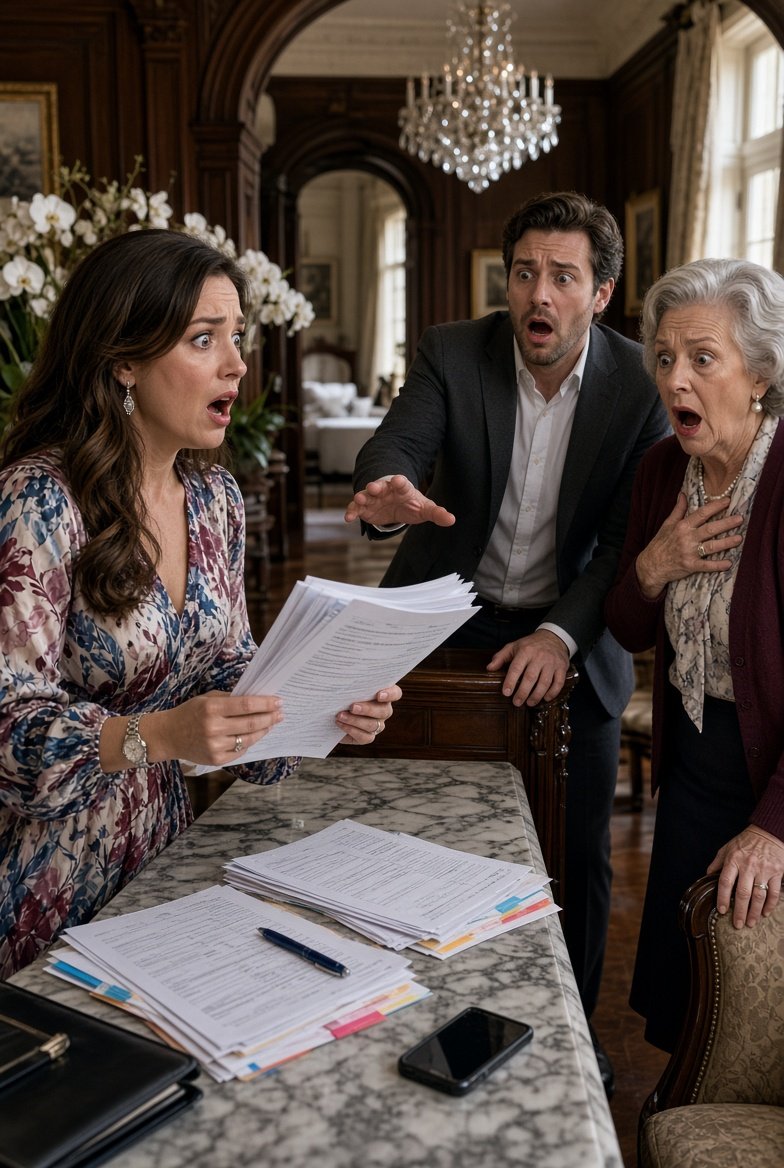
Three weeks ago, Emmett had placed four documents before my bleary eyes, murmuring that they were state insurance declarations for Lorna’s disability coverage.
I had signed every single one without reading them.