
Chapter 4: The Ledger of Cruelty
The silence that followed was heavy enough to bend pine.
Lorna did not faint. She did not retreat to her bed to hide under the quilted coverlet. When an experienced swindler realizes the mark has discovered the marked deck, she does not weep; she recalculates the odds.
Slowly, methodically, she smoothed down the lapels of her lilac robe. The manufactured hunch vanished from her posture. She pulled out Ada’s high-backed kitchen chair, sat down, crossed one slender leg over the other, and rested her steady hands upon the table.
“You’re smarter than Emmett gave you credit for,” she remarked.
Her voice had undergone a complete transmutation. It was dry, analytical, punctuated by that flat, clipped Ohio inflection she had honed over nearly four decades of filing property deeds.
“He always was an atrocious judge of character,” she continued, her lips curling into a pale, thin sneer. “He thought you were just another sweet, soft-hearted church girl who liked to play Florence Nightingale. I told him back in July that you were watching the margins too closely. I told him your silence wasn’t stupidity.”
My hands shook, but not from terror. They shook from the violent adrenaline of a survivor who has just spotted the fin breaking the surface of the water. I walked back to the stove, poured two mugs of black coffee, set one before her, and took the chair directly opposite.
“Talk,” I said. “And do not omit a single syllable, Lorna. Because every lie that leaves your mouth between now and nine o’clock will be added directly to the formal statement I provide to the Montgomery County Prosecutor’s Office.”
She took a deliberate, unhurried sip of the steaming coffee, her eyes never breaking contact with mine. She wasn’t ashamed. If anything, there was a grotesque, festering pride radiating from her pores. She had executed an eight-month psychological operation of staggering complexity, and she was finally being afforded an audience capable of appreciating the tradecraft.
“Emmett is drowning,” she began casually, as if reviewing an unexceptional municipal audit. “His restaurant supply territory collapsed in the third quarter of last year. Three major franchise groups canceled their kitchen modernizations. He couldn’t make the commercial quota. He took out an unauthorized line of credit against his regional account to cover his draw, then he maxed out two business credit cards, then he leveraged his pickup truck.”
“How much?” I asked, my voice clicking like an adding machine.
“Sixty-two thousand dollars in unsecured commercial debt,” she answered without blinking. “Plus back taxes. The collection agencies were preparing to freeze his assets by Christmas. And if his corporate headquarters discovered he had leveraged equipment orders that hadn’t been delivered, they wouldn’t just terminate him, Renata. They would have filed commercial embezzlement charges.”
I felt the blood drain from my ears. “And so the devoted mother stepped in.”
“A son is a mother’s investment,” she stated coldly. “Emmett is weak. He has his father’s soft jaw. Left to his own devices, he would have collapsed on your kitchen rug, sobbed like a beaten hound, and begged you to mortgage this house to save him. And do you know what would have happened then?”
She leaned forward, her eyes narrowing into slits.
“You would have consulted a divorce attorney,” she whispered with venomous certainty. “You’re an administrator. You understand liabilities. You would have calculated that his debt exceeded his sentimental value, you would have locked this separate property tight behind pre-marital inheritance statutes, and you would have cast him onto the street. I was not about to allow my son to spend the next decade in bankruptcy court while you sat pretty on three hundred thousand dollars of unencumbered brick.”
“So you invented dementia,” I said, the words tasting like lead on my tongue. “You let me wipe your mouth. You let me scrub your body.”
“A desperate woman signs nothing,” Lorna replied, her tone chillingly pedagogical. “An angry woman calls a lawyer. But an exhausted woman? A guilt-ridden, isolated, bone-tired martyr who believes she is performing a holy duty for a dying elder? She signs whatever you put in front of her. If she’s tired enough, reading the fine print feels like an admission that she isn’t strong enough to be a saint anymore.”
She laid out the mechanics of their crime with the dispassionate clarity of a clerk reading a tax roll:
Emmett had recruited Dr. Halloway—an ancient family acquaintance who owed Lorna’s late husband several old political favors from the municipal zoning boards—to scribble vague notations of “progressive cognitive instability” into a preliminary chart without subjecting her to a formal neuropsychological assessment or an MRI scan. That paper trail was all they needed to justify moving her into my home, effectively severing me from my forty-five-thousand-dollar annual salary, my professional autonomy, and my external support network.
And the papers three weeks ago?
They were not insurance documents.
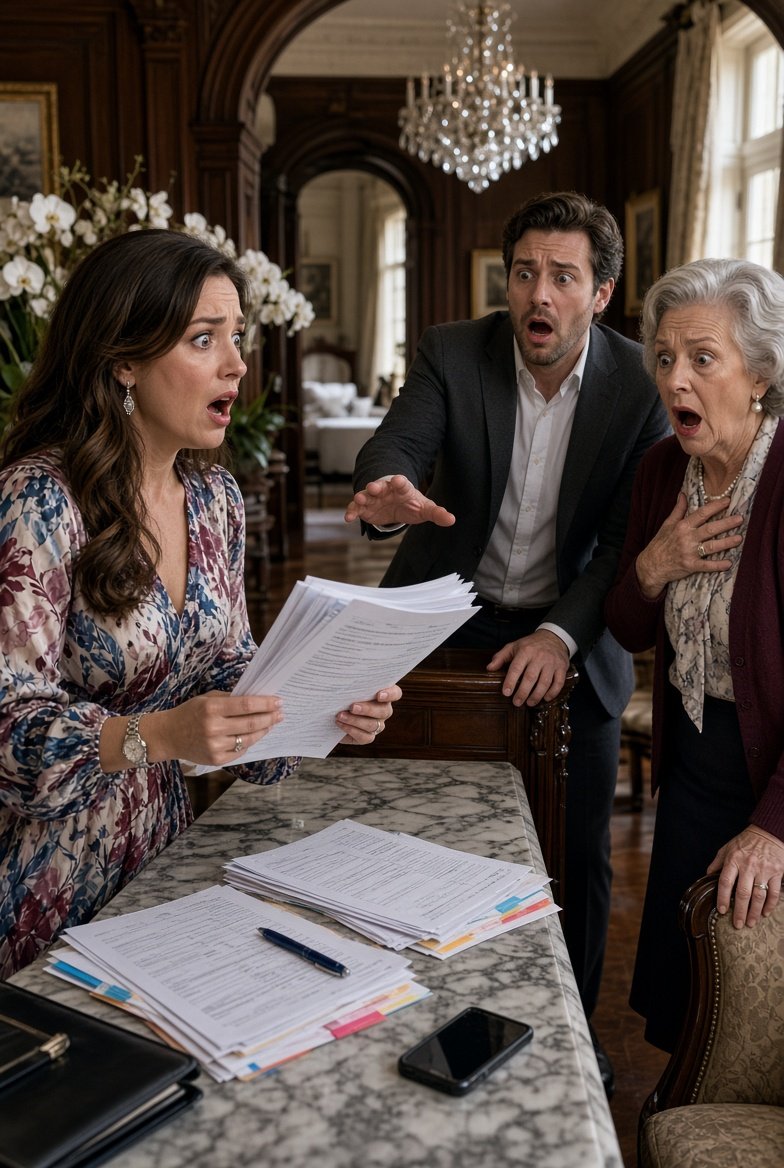
They were an application for a Home Equity Line of Credit (HELOC) in the amount of sixty thousand dollars, secured entirely against Ada’s unencumbered colonial. Accompanying the loan packet was a fabricated quitclaim deed rider purporting to convey a survivorship interest in the real estate to Emmett Vulk, transforming my grandmother’s legacy into a joint marital asset.
“The loan closes Friday afternoon,” Lorna concluded, dabbing her lips with a paper napkin. “The funds were to be wired directly into an offshore commercial clearing account in Delaware that Emmett established last month. Once the debts were settled, I was scheduled to have a ‘miraculous stabilization’ through a new holistic medication regimen. We would have vacated this drafty mausoleum, and you would have spent the next twenty years paying off the note. A neat, quiet transaction.”
I sat across from her, listening to the grandfather clock measure out the seconds. Outside, the autumn wind rustled the dying maple leaves against the windowpane.
“Why did you participate?” I asked softly. “You didn’t need the money. You own your ranch house in Huber Heights outright.”
For the first time that morning, something dark, ancient, and profoundly bitter fractured the polished enamel of her face.
“Because he would have botched it,” she hissed, her voice trembling with a terrifying maternal disgust. “He would have lost his nerve at the eleventh hour. He would have broken down, told you the truth, and allowed you to manage him like a truant schoolboy. I raised Emmett to take what he needs to survive! If he was going to execute a coup, he was going to do it with a spine. I stayed here to ensure he didn’t blink.”
I stood up from the table.
My knees did not tremble. The fog that had weighed upon my brain for two hundred and forty days had evaporated, leaving behind a cold, crystalline architecture of fury.
“Go to your room, Lorna,” I said evenly.
She arched a silver eyebrow. “And what are you planning to do, little girl? Call Emmett? He won’t answer his phone while he’s pitching corporate clients.”
“I am not calling my husband,” I replied, turning my back to her and setting the empty mugs into the sink. “And if you pick up that receiver or attempt to leave this residence before I return, I will phone the Dayton Police Department and report that an unregistered intruder is occupying my property under false pretenses. Pack your leather valise. You won’t be sleeping under Ada’s roof tonight.”
I locked myself into the downstairs bathroom.
I did not sit upon the edge of the tub to weep. I sat upon the edge of the tub, pulled Ada’s antique address book from my leather purse, flipped past the names of relatives who had passed before the millennium, and placed my index finger upon a number I hadn’t dialed in seven years:
Warren Soel, Esq. Attorney-at-Law. Specialist in Estates, Deeds, and Probates.
The man who had promised my dying grandmother that he would watch over the girl with the seed-pearl earrings.