
Chapter 7: The Architecture of True Mercy
The law moves with the agonizing, unglamorous pace of a glacier.
Real life does not conclude with a dramatic gavel strike forty-eight hours after the revelation. It concludes with hundreds of pages of legal depositions, certified mail receipts, bank audits, and sterile conference rooms smelling of stale carpet and lukewarm institutional coffee.
It took me nine full days of silence to choose Road Two.
I spent those nine days alone in my grandmother’s house. I stripped the yellow guest room down to the baseboards. I tore down the grab bars, patched the screw holes in the drywall, and dragged the shower stool out to the curb for the Wednesday refuse collection. I sat on the porch every evening, watching the helicopter seeds drift from the maple tree, listening to the silence of my own thoughts.
Warren Soel had been right: mercy without consequences is merely cowardice wearing a halo.
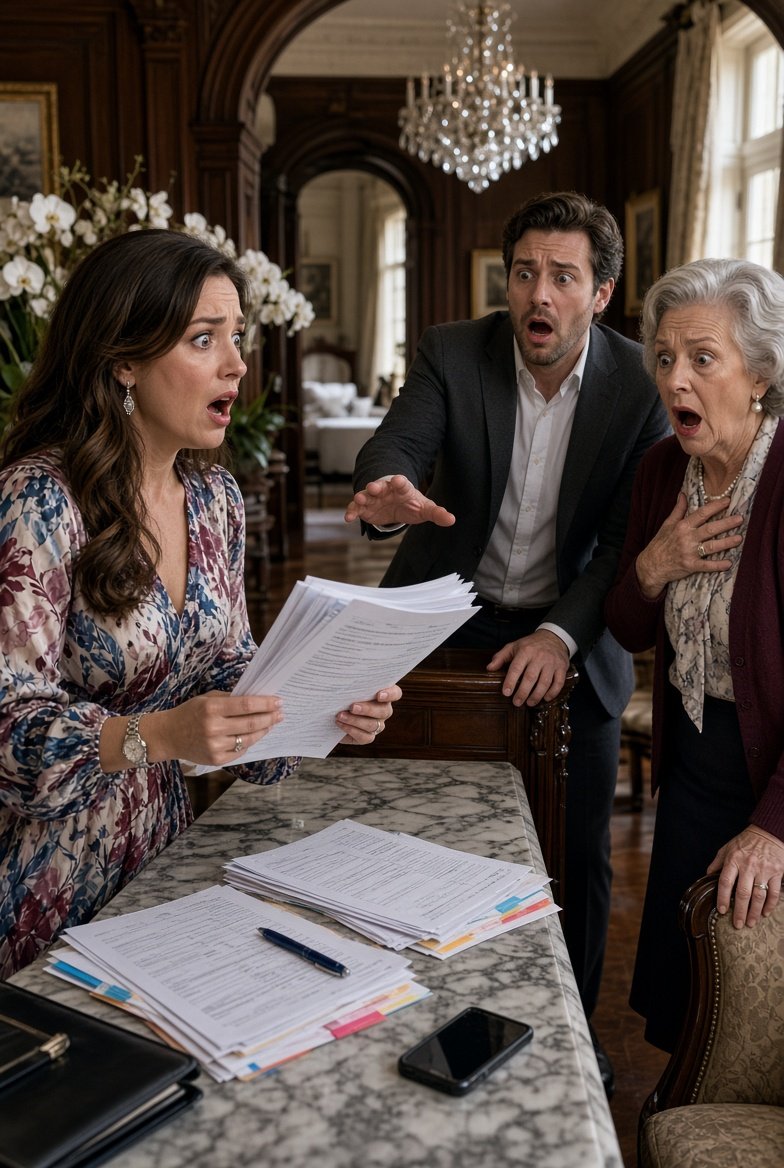
On the tenth morning, I walked into the Montgomery County Common Pleas Court alongside Warren, carrying a black leather accordion file containing eight months of pharmacy receipts, the forged equity addendum, and Marcus Vance’s notarization logbook.
The prosecution moved swiftly once the financial trail was illuminated. Marcus Vance folded within forty-eight hours of his first interview, surrendering his notarial commission and providing state’s evidence against Emmett in exchange for a suspended misdemeanor sentence.
Emmett Vulk was indicted by a grand jury on two counts of felony forgery, one count of attempted grand theft, and one count of identity fraud. He did not go to a maximum-security penitentiary for a decade; the judicial system does not operate like a Hollywood vengeance drama. Because he was a first-time offender, and because Warren insisted on full restitution for legal expenses as a condition of our expedited civil divorce, Emmett entered a negotiated guilty plea to a reduced third-degree felony.
He received five years of intense community supervision, three hundred hours of mandatory community service, and an order of formal restitution totaling eighteen thousand dollars.
The real sentence, however, was written into his commercial record. A man cannot market industrial kitchen infrastructure to corporate schools, hospitals, and municipal institutions when a criminal background check flags him as a convicted commercial forger. His sales career vanished overnight. The last I heard through a mutual acquaintance, he was managing a third-tier auto-salvage lot on the outskirts of Springfield, living in a rented cinderblock duplex, his charming smile long since calcified into permanent, bitter exhaustion.
Lorna was never criminally indicted.
The prosecutor concluded that proving her complicity in the specific mechanical act of the forgery before a jury would be extraordinarily difficult given that her signature appeared on no financial instruments, and no court wished to bear the public-relations burden of prosecuting a seventy-one-year-old widow who could simply resume her theatrical invalidity the moment she reached the witness box.
I accepted that outcome without rancor.
Lorna lost the only asset she had ever genuinely valued: her absolute dominion over her son’s destiny. She had staged an eight-month masterpiece of deception only to ensure that her son became precisely what she feared most—a broken, ruined, exposed failure who will spend his middle age paying off court assessments. She lives alone in her ranch house in Huber Heights, her shades drawn, her telephone unlisted, ignored by the community she once sought to impress.
Four months after the finalization of our divorce, Lorna phoned me once from a payphone. She requested an audience at a diner on Brandt Pike.
I went. Not because I sought reconciliation, but because I wanted to ensure that no ghosts remained lurking in my rearview mirror.
She looked ancient. The performance was gone, replaced by the genuine, irreversible decay of bitter age. Her silver hair was unwashed, her hands stained with nicotine.
“I’m not apologizing,” she croaked over her chipped porcelain mug. “I don’t regret trying to save my boy.”
“I know,” I answered calmly.
“You were too hard,” she muttered, her eyes glaring at me through the steam. “A good daughter-in-law would have absorbed the blow. You had the house. You had the resources. You broke him because your pride couldn’t tolerate being fooled.”
“I didn’t break him, Lorna,” I replied, setting a five-dollar bill onto the table to cover my black tea. “I simply refused to let him use my grandmother’s bones to pave his driveway. There is a profound difference between being gentle and being a doormat. You taught me that difference. It was the only genuine gift you ever gave me.”
I stood up, walked out into the cold Ohio sunshine, and never looked back.
Today, fourteen months after that Tuesday night in October, the red-brick house on Hickory Street smells of fresh white-pine shavings and lavender.
I reclaimed my former post as practice administrator at the dental clinic in Kettering. On my first morning back behind the desk, organizing the accounts and balancing the ledger down to the penny, Dr. Miller placed a small brass vase of yellow daisies on my blotter and whispered, “The ship runs straight again.”
Last weekend, I finally repainted the downstairs bedroom.
I stripped away every trace of the soothing yellow paint I had selected for an invalid who was laughing at my simplicity. I rolled two thick coats of cool, elegant slate-gray across the walls—the exact shade Ada had chosen when she kept her antique Singer sewing machine in the corner. I purchased a cherrywood drafting desk, installed two bright brass reading lamps, and converted the space into my personal office and library.
I do not measure oatmeal anymore. I do not monitor brown sugar by the quarter-teaspoon.
Sometimes, when the wind kicks up through the silver maple in the yard, showering the broad wooden porch with thousands of winged helicopter seeds, I sit by the window with a cup of hot black tea and listen to the house settle on its ancient stone foundation.
People often ask me, usually after a glass of wine when the conversation turns to the wreckage of past relationships, if I hate them for stealing eight months of my life.
The truth is, I don’t.
If Lorna Vulk had not faked her madness, if she had not sprinted across my kitchen with iron fingers to save her stolen transfer, I might have spent forty years asleep beside a man who was quietly hollowing out my soul. She didn’t destroy my life; she accidentally gave it back to me. She proved that the soft place in my heart—the capacity to love, to care, to sacrifice for the vulnerable—was not a fatal flaw.
The flaw was believing that love required me to lay down my weapons.
Now, my ledgers are balanced. My doors are bolted with brass deadbolts. And under Ada’s red-brick roof, nobody signs anything unless they have read every single word.
Like and share this post if you find it interesting.